
Call Us
0086-13486123098 0086-571-58838718
Send Us
- All
- Product Name
- Product Keyword
- Product Model
- Product Summary
- Product Description
- Multi Field Search
Views: 0 Author: Site Editor Publish Time: 2025-10-27 Origin: Site


Selecting the right motor for a precise rolling mill is crucial for efficient and high-quality metal processing. Rolling mills rely on motors to provide consistent speed, torque, and control, directly affecting product uniformity, production rate, and energy consumption. With so many motor types, capacities, and control technologies available, it can be overwhelming to determine which one best fits your mill. Understanding the specific requirements of your materials, production scale, and desired output is the first step in making a smart choice.
Choosing the proper motor not only improves rolling performance but also reduces downtime, energy costs, and maintenance needs. This guide explores key factors in selecting a suitable precise rolling mill motor, from motor types and torque requirements to speed control, efficiency, and integration.
Before selecting any motor, we must fully understand the rolling mill’s requirements. Metals differ in hardness, elasticity, and thickness, all of which influence the motor needed. For instance, thick steel plates demand high torque to deform smoothly, whereas thin aluminum sheets require faster speed and more precise control. Production scale also matters: a small workshop may operate a medium-capacity motor, while large industrial plants need motors capable of sustaining continuous high load.
Product variety is another consideration. Rolling a single-size sheet is simpler than producing multiple gauges or shapes. Additionally, your production process, whether heavy plate rolling, wire drawing, or sheet rolling, determines the technical demands placed on the motor.
There are three common motor types used in precise rolling mills, each offering distinct advantages.
| Motor Type | Advantages | Best Applications |
|---|---|---|
| DC Motor | Excellent speed regulation, high torque, adaptable to load changes | Medium-sized rolling mills needing precise control |
| AC Induction Motor | Reliable, simple, low maintenance, cost-effective | Less demanding mills or processes not requiring tight speed control |
| Servo Motor | Extremely precise, dynamic response, high torque at low speeds | High-precision rolling, automated control, complex motion requirements |
DC motors have a long history in rolling mills due to their adaptability. AC motors, especially with variable frequency drives (VFDs), now offer better speed control and efficiency, making them more versatile than before. Servo motors excel in applications requiring tight regulation of speed, torque, and position.
One of the most critical steps is calculating the motor’s power and torque. They must handle the rolling force generated by the mill, the speed at which the material is processed, and the inertia of the rotating components. Friction and load fluctuations also influence the required torque.
Selecting an underpowered motor can cause slow production and potential damage, while over-sizing leads to wasted energy and higher operational costs. Engineers usually calculate power using formulas based on rolling force and mechanical efficiency, ensuring a motor meets peak demands without unnecessary oversizing.
Torque Requirements by Material Type:
| Material | Typical Thickness | Recommended Torque |
|---|---|---|
| Steel | 20–25 mm | High |
| Aluminum | 5–10 mm | Medium |
| Copper | 8–12 mm | Medium-High |
These numbers serve as guidance to match the motor’s capacity with the material’s characteristics.
Maintaining a consistent speed is vital in rolling operations. Small speed fluctuations can lead to defects such as uneven thickness, warping, or surface imperfections. Even minor inconsistencies can reduce product quality, especially when rolling high-precision sheets, wires, or plates.
Modern rolling mills often use Variable Frequency Drives (VFDs) for AC motors and servo drives for servo motors. These systems allow the motor to respond instantly to load changes. For example, when a thicker section of metal passes through the rolls, the drive adjusts torque to maintain a stable speed. This prevents stress on the material and reduces the risk of machine strain.
Beyond regulating speed, these drives can be integrated with the rolling mill’s digital control system. They allow automated adjustments, real-time monitoring, and synchronization across multiple stands. As a result, operators can maintain high-quality output with less manual intervention, ensuring efficiency even under variable production conditions.
Rolling mill motors often run continuously for long hours. Inefficient motors consume more electricity and produce excess heat, which can strain the mill and shorten component lifespan. Choosing high-efficiency motors, such as those rated IE3 or IE4, reduces energy consumption without compromising performance.
Some modern motors include regenerative braking, a feature that recovers energy when the motor slows down. This recovered energy can be reused in the system, cutting electricity costs over time. Other features, like optimized cooling and low-loss magnetic materials, further improve efficiency, especially in heavy-load or high-speed rolling applications.
Although high-efficiency motors may have a higher initial cost, they provide long-term savings. Reduced energy use lowers operating costs, decreases heat generation in the mill, and can extend the service life of both the motor and surrounding equipment. They also support sustainability initiatives by minimizing environmental impact.
Rolling mills operate under heavy stress, dust, moisture, and fluctuating temperatures. Motors designed for these conditions have robust housings, quality insulation, and protective seals. Reliable motors reduce unplanned downtime and ensure smooth production, even in demanding environments.
Ease of maintenance is essential. Motors should allow quick inspection, simple lubrication, and easy replacement of components. Features like modular construction or quick-access panels simplify routine maintenance tasks and reduce service time.
Choosing a motor from a supplier that provides readily available spare parts and technical support is critical. Immediate access to replacements or guidance minimizes production interruptions and extends the motor’s lifespan. Ultimately, a well-maintained, reliable motor ensures consistent output for years.
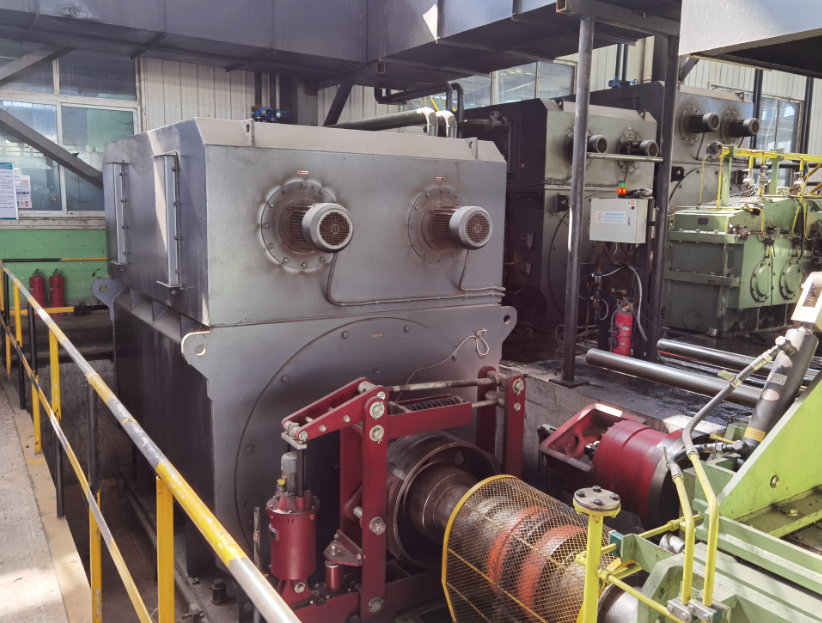
Modern rolling mills rely on digital control for automated and precise operations. The motor must respond accurately to commands from the mill’s control system. This includes adjusting speed, torque, and acceleration based on material flow and rolling conditions. Seamless integration allows multiple stands to work in synchronization, preventing uneven deformation and improving product quality.
Motors often need to interface with PLCs, SCADA systems, or other industrial controllers. Communication protocols, such as Modbus, Profibus, or CAN, are commonly used. Choosing a motor compatible with your existing control network simplifies programming and reduces installation time. This ensures the system can monitor performance, detect anomalies, and automatically adjust settings for optimal operation.
A motor that is incompatible in size, voltage, or communication can cause serious problems. Misalignment may lead to excessive vibration, wear, or premature failure. Electrical incompatibility can damage the motor or control system. Working with a supplier that provides integration support helps prevent these issues. They can guide proper installation, calibrate control settings, and ensure smooth operation from day one.
Different rolling mills require tailored motor solutions:
Heavy Plate Rolling Mills: Require motors with high torque and rigidity, often operating at slower speeds to deform thick steel efficiently.
Wire Rolling Mills: Need moderate torque but high-speed capability, emphasizing precise thickness control.
Sheet Rolling Mills: Balance torque and speed, ensuring smooth material flow and uniform thickness across large sheets.
Understanding the mill type, material, and desired output helps engineers select the motor that meets both production and efficiency requirements.
You should evaluate the material type, thickness, production speed, product variety, and rolling process. These factors determine the required torque, power, and motor control features.
The best motor type depends on your specific requirements. DC motors are well-suited for medium-sized rolling mills that need precise speed control, while AC induction motors provide reliable and cost-effective performance for less demanding applications. Servo motors, on the other hand, deliver high precision, excellent torque at low speeds, and dynamic response, making them ideal for complex or high-precision rolling operations.
Torque depends on the material’s resistance, thickness, and the inertia of rotating components. Power is calculated based on rolling force, speed, and mill efficiency. Overestimating wastes energy; underestimating can cause poor performance.
Consistent speed prevents uneven thickness, warping, and surface defects. Advanced drives like VFDs and servo systems dynamically adjust torque, maintaining stable speed even under load variations.
Yes. High-efficiency motors (IE3, IE4) reduce electricity use, generate less heat, and extend equipment life. Features like regenerative braking can recover energy during deceleration, cutting operational costs.
Selecting a precise rolling mill motor is a critical decision that influences productivity, product quality, and long-term operational efficiency. By considering material characteristics, torque and power requirements, speed regulation, energy efficiency, reliability, and system compatibility, operators can make informed choices that optimize mill performance.
Partnering with an experienced supplier like Hangzhou New Hengli Electric Machine MFG. Co., Ltd. ensures access to high-quality motors, technical guidance, and integration support. Their solutions help rolling mills achieve stable operation, precise control, and consistent output, maximizing both production efficiency and return on investment.
